
On Friday, June 5, 2026, a commemorative ceremony to celebrate the establishment of NAUTILUS(Joint Research Promotion Base with JSTRA) was held at the Rakusui Hall on the Shinagawa Campus of Tokyo University of Marine Science and Technology(TUMSAT).
NAUTILUS*¹ was established with Professor Tadatsugu Okazaki, Director of Research Center for Next-Generation Ship Operation Technology, serving as the Base Director. Working in close cooperation with the center—an internal joint-use facility of TUMSAT—the base aims to contribute to human resource development and the formulation of international rules at the International Maritime Organization (IMO) and other bodies.
The ceremony commenced under the facilitation of Professor Etsuro Shimizu, Research Manager at Research Center for Next-Generation Ship Operation Technology. To open the event, Toshio Iseki, President of TUMSAT, delivered an address on the significance of establishing this base and his expectations for its future.This was followed by remarks from Seiichi Tanaka, Chairman of JSTRA, who expressed JSTRA’s high expectations for the newly formed base.
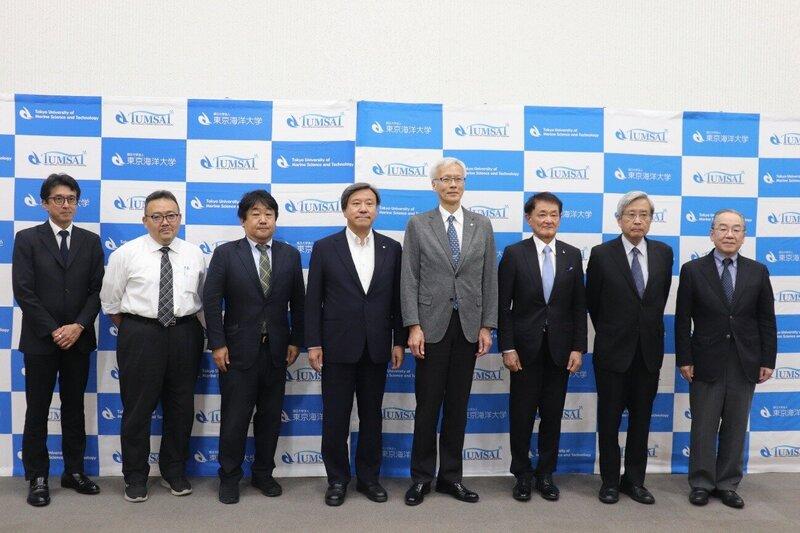
From left: (TUMSAT) Research Manager Shimizu, Specially Appointed Professor Omura, Center Director Okazaki, Board Member Maita, President Iseki, (JSTRA) Chairman Tanaka, President Ishikawa, Executive Managing Director Kato
Subsequently, as an overview of the initiative, Research Manager Shimizu introduced the purpose of establishing the Research Center for Next-Generation Ship Operation Technology, which serves as the foundation for the base. He outlined current initiatives and plans (focusing on autonomous ships, alternative fuel ships, and maritime digital transformation [DX]), and shared expectations for further revitalizing research and development while enhancing social value through the construction of this base.
Next, Koichi Kato, Executive Managing Director of JSTRA, provided an overview of JSTRA and presented the policy to focus on two areas—ballast water management and biofouling management—as the immediate priority activities for NAUTILUS. Furthermore, since both priority areas involve the environment and biology, it was reported that Takuo Omura, an expert in these fields with extensive experience participating in IMO meetings, has been appointed as a Specially Appointed Professor.
During the Q&A session, attendees asked lively questions regarding the future outlook and details of the activities. Specially Appointed Professor Omura, seconded from JSTRA, encouraged corporate stakeholders to feel free to visit the base, reflecting the high expectations for the base’s further development. Finally, a commemorative photograph was taken, and the ceremony concluded on a high note.
The event was attended by President Iseki, Vice President Maita (in charge of Research, International Affairs, and Academic Information), Base Director Okazaki (Director of the Research Center for Next-Generation Ship Operation Technology), Research Manager Shimizu, and Specially Appointed Professor Takuo Omura from TUMSAT. Representing JSTRA were Chairman Tanaka, President Ishikawa, Executive Managing Director Kato, and Deputy Director Hasegawa of the Standards & Regulations Group.
Under the leadership of Specially Appointed Professor Omura, NAUTILUS will actively address IMO issues, moving beyond the challenges of ballast water and biofouling management.
*1 What is NAUTILUS?
NAUTILUS stands for Navigation Advanced Unified Technology Innovation Laboratory for Unique Seamanship.
The word “NAUTILUS” originates from the Greek word ναυτίλος (nautilos), meaning “sailor” or “mariner,” in English. This reflects both the base’s mission to train and educate seafarers and the distinctive identity of TUMSAT.
Furthermore, as a biological name, “nautilus” refers to the chambered nautilus, a creature whose name itself shares its etymological roots with words for “ship” and “voyager.” The compartmentalized structure of the nautilus shell, divided into numerous internal chambers, visually and symbolically represents the philosophy of collaborative research: “forming a unified whole through the gathering of individual parts.”
About the Research Center for Next-Generation Ship Operation Technology, Tokyo University of Marine Science and Technology (TUMSAT)
Established in November 2025 as a new internal joint-use facility at TUMSAT, the center aims to contribute to the formulation of international rules and human resource development for next-generation ship operation. Led by Center Director Professor Tadatsugu Okazaki from the Department of Maritime Systems Engineering, and with Professor Etsuro Shimizu from the Department of Marine Electronics and Mechanical Engineering serving as the Research Manager, the center advances its research through three dedicated groups: the Autonomous Ships Group, the Maritime DX (Digital Transformation) Group, and the Alternative Fuel Ships Group.
About the Japan Ship Technology Research Association (JSTRA)
JSTRA is a research, development, and survey organization that serves as an industry-academia-government collaborative platform aimed at strengthening the technological foundation of Japan’s maritime industry. One of its core operations is supporting research, studies, and policy-making for international maritime regulations at the International Maritime Organization (IMO). In the area of environmental regulations, JSTRA bridges industry, academia, and government across a wide range of fields, including ballast water management, biofouling management, and regulations related to the International Convention for the Prevention of Pollution from Ships (MARPOL).
