
The Arctic continues to shape Canada’s future through its diverse cultures and thriving communities, as well as its critical role in supply chains, economic opportunities, climate research, and northern security and sovereignty.
Now, a new five-year agreement signed on September 7th positions the Fisheries and Marine Institute of Memorial University at the centre of Canada’s education, training and applied research relationship with its Nordic partners to ensure readiness in many areas.
The framework comes in direct support of national priorities under the Icebreaker Collaboration Effort (ICE Pact), a trilateral agreement aimed at strengthening Arctic capabilities through partnerships on advanced ice-class ship design, workforce development, and more.
The new MOU commits both institutions, members of the International Association of Maritime Universities (IAMU), to advancing Canada’s and Finland’s defence innovation ecosystems. It combines strengths in applied R&D, training, workforce development, and industry collaboration.
The partnership will focus on activity including advancing co-innovation, collaborating on talent and workforce development, building cooperation through the International Association of Maritime Universities (IAMU), and aligning technology efforts with defence, marine and security priorities.
“Canada’s Arctic ambitions will be delivered by people. Designers, engineers, navigators, technologists and researchers will all be needed. This agreement with SAMK gives us a trusted Finnish partner to develop that talent together, and it puts Memorial University where it should be – at the centre of Canada’s education, training and applied research relationship with our Nordic allies.”
– Dr. Paul Brett, Deputy Provost (Marine Institute) and Executive Director (Professional and Continuing Education) (Interim)
In April 2026, Canada and Finland formalized closer maritime cooperation through an MOU focused on icebreaking, shipbuilding, and Arctic capabilities. The two countries also pledged to expand collaboration in research, education, and maritime safety, with a particular focus on the Arctic. That government-to-government vision now needs institutional action, and the MI-SAMK agreement helps deliver it.
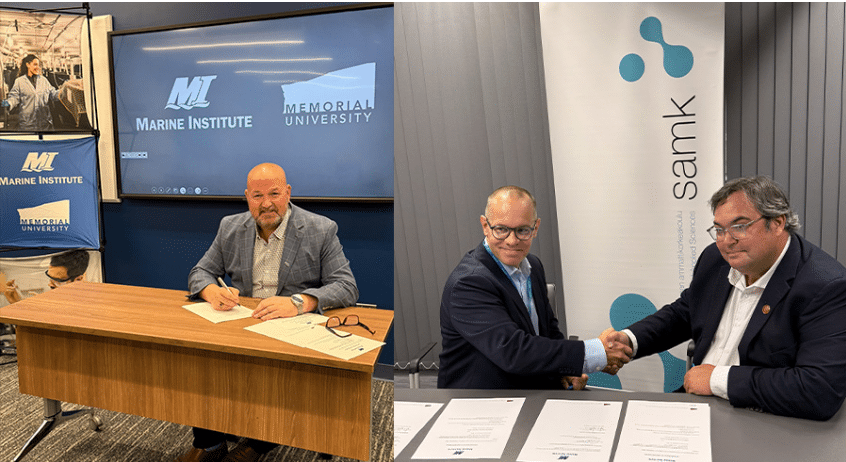
MI brings expertise in marine simulation, ice navigation, ship design, offshore safety, marine engineering, ocean technology and industry-driven training. SAMK contributes strengths in maritime safety, logistics, digitalization, maritime management and marine technology through its Maritime Logistics Research Centre and degree programs.
“Finland and Canada share cold seas, high standards and a common interest in safe, secure navigation in northern waters. Working with the Marine Institute allows us to connect our maritime logistics, safety and security-of-supply research to a partner with world-leading capability in cold-ocean training and simulation.”
– Heikki Haaparanta, Vice President, Satakunta University of Applied Sciences
NL & the Trans-Arctic Connector
For the Marine Institute and Memorial University as a whole, this agreement continues a deliberate pattern of North Atlantic, Arctic and Nordic relationship-building. Ice, weather, distance and cold-ocean risk are daily operating environments that shape MI’s teaching, simulation and research.
Under the MOU, the parties will pursue specific agreements in areas expected to include student and faculty mobility, joint and articulated program development, shared simulation and research infrastructure, collaborative applied research proposals, and industry-facing upskilling for the marine and defence workforce.
Reported by Capt. Kristopher Drodge
Head, School of Maritime Studies,
Fisheries and Marine Institute of Memorial University
